South Carolina Bill Would Bar H-1B and OPT Workers From State Incentive Programs
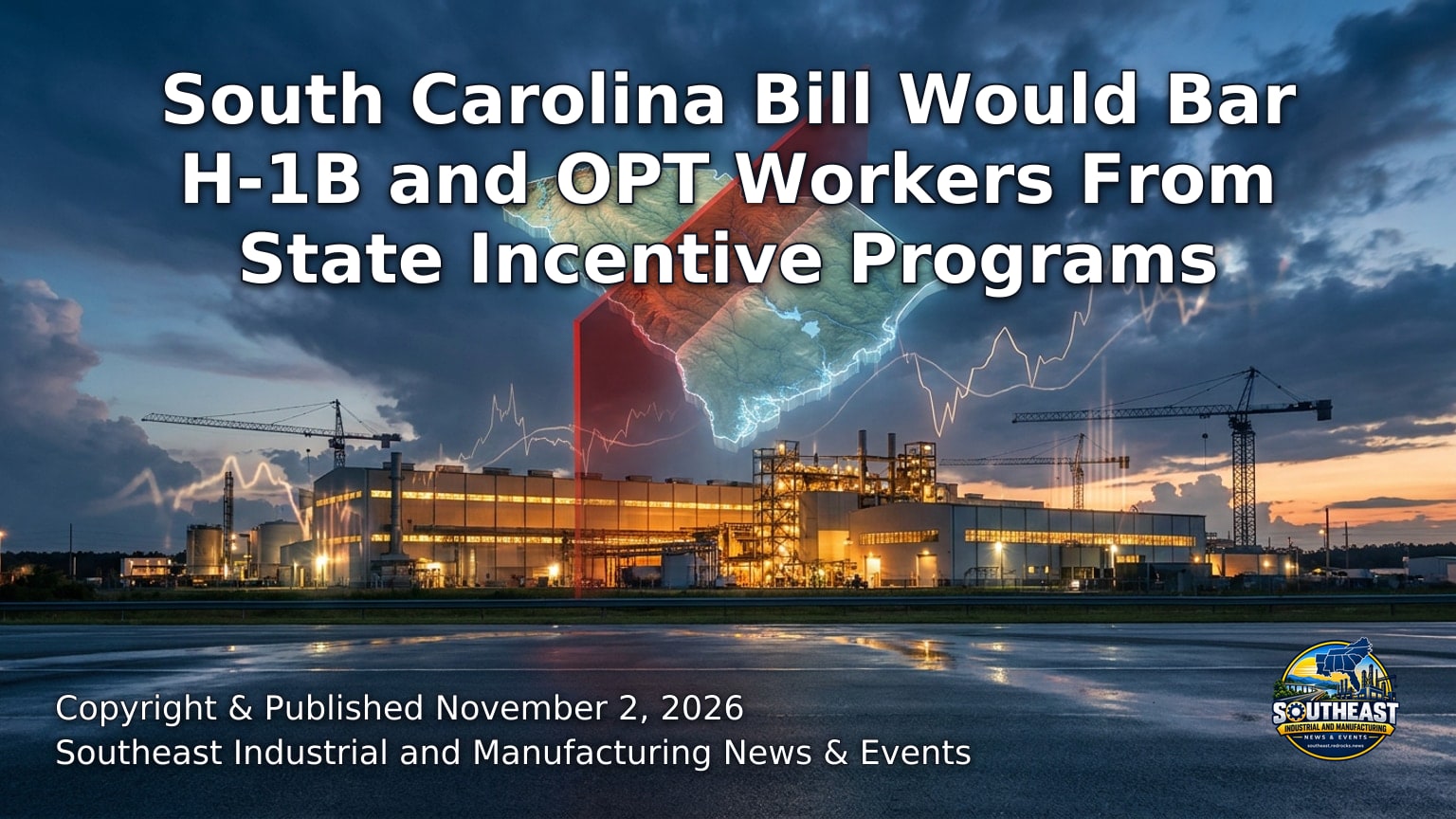
Original illustration created for Southeast Industrial and Manufacturing News & Events.

A bill filed in the South Carolina House would strip job tax credits, fee-in-lieu-of-property-tax deals and sales tax exemptions from any company that employs a worker on an H-1B or Optional Practical Training visa. H. 4615, filed by Rep. Jordan Pace and co-sponsored by Reps. Edgerton, Magnuson and White, was introduced January 13, 2026, and carries an effective date of July 1, 2027, according to the bill text posted on South Carolina Legislature Online.
That is not a small category of incentive. The bill would add Section 11-1-130 to the state code and name the Job Development Credit, FILOT agreements and sales tax exemptions explicitly as programs off-limits to any employer with an H-1B or OPT worker on payroll in the United States.
What the bill actually bars
The Job Development Credit, one of South Carolina Commerce's primary discretionary tools, requires a company to create at least 10 new full-time jobs and provide health benefits before it can reimburse approved project costs out of employee withholding, according to South Carolina Department of Commerce materials published October 13, 2026. Under H. 4615, a single H-1B hire anywhere in a company's U.S. workforce would disqualify it from that program, along with FILOT and sales tax relief — the three incentive types manufacturers use most when negotiating a new line or an expansion in the state.
The bill has company. H. 5273, filed by Rep. Long and posted to the legislature's site on February 26, 2026, takes a narrower approach: a company loses eligibility for state incentives only if H-1B visa holders exceed 2% of its total workforce. Where Pace's bill is a hard bar triggered by a single hire, Long's is a threshold test — two different mechanisms aimed at the same target, moving through the chamber at the same time.
The question nobody has answered yet
H. 4615 does not take effect until July 1, 2027, and nothing in the filed text addresses companies already operating under existing FILOT or Job Development Credit agreements. The bill bars incentive eligibility for employers with H-1B or OPT workers; it does not say whether that bar reaches agreements signed before July 2027 or applies only to incentive applications filed after that date.
That distinction is the one every project-finance desk negotiating a South Carolina deal right now will need answered before this bill moves further. A FILOT agreement for a battery plant or metals facility typically runs the life of the investment, not a single budget cycle. Nothing in the bill text carves out a grandfather clause, and no committee hearing record has yet been posted that addresses legislative intent on existing agreements.
The wage-gap argument behind it
Pace's bill moved through a legislature already primed by federal action on H-1B hiring. A September 18 executive order directed federal agencies to increase scrutiny of H-1B petitions to protect domestic wages. On October 8, Vice President J.D. Vance led a press conference announcing that the Department of Labor would suspend PERM permanent labor certification processing — the track that moves H-1B holders toward green cards — for eight technology and IT services firms, tying the action to "wage suppression" and the displacement of American workers, according to the Department of Labor's October 8 announcement.
Pace's bill does something different: it doesn't touch what H-1B workers get paid, it makes employing them incompatible with South Carolina economic development money at all.
Congress has its own version of this fight. Rep. Chip Roy introduced the American White-Collar Worker Jobs Act of 2026 on June 4, which would eliminate the OPT program and replace the H-1B lottery with wage-based selection. Roy said the H-1B program has allowed employers to "routinely sideline American STEM workers in favor of cheap foreign labor," according to his office's June 4 announcement. Co-sponsor Rep. Eli Crane has separately proposed a three-year pause on H-1B issuance altogether.
Who this hits in South Carolina
The incentive programs at stake cover entire projects, not single job categories. A FILOT agreement or Job Development Credit negotiated for a plant expansion names a single employer, not a department, which means H. 4615 does not carve out an exception for a company that employs one specialist on an H-1B visa while hiring hundreds of production workers domestically. The bar as filed applies to the whole incentive package.
That is the structural problem the ACLU of South Carolina flagged in its formal opposition, filed the same day the bill was introduced. The organization said the measure would be "harmful to both immigrants and businesses in South Carolina," arguing that disqualification from incentives like infrastructure support and property tax credits would create additional hurdles for companies that rely on specialized visa-holding talent for roles they cannot fill domestically.
Part of a pattern, not an outlier
H. 4615 is not South Carolina's first move this year toward conditioning state-funded economic activity on domestic labor and materials. Gov. Henry McMaster signed H. 4709, the Buy American Iron and Steel Act, into law on June 30, 2026, mandating U.S.-produced iron and steel on most state-funded public works projects. Sponsor Rep. Richie Yow framed the law as protection for jobs at facilities like Nucor Steel in Darlington, according to ConstructConnect News's July 6 coverage of the signing.
That law and H. 4615 are aimed at different inputs — materials sourcing in one case, visa hiring in the other — but they share a legislative instinct: use the state's incentive and procurement leverage to enforce domestic-labor preferences rather than relying on federal immigration or trade policy alone.
For now, two bills — Pace's hard bar and Long's 2% threshold — are moving on parallel tracks through the same legislature, alongside a federal enforcement push that has already suspended PERM certification processing for eight named firms elsewhere in the country. Plant managers negotiating new incentive packages in South Carolina have a harder question to answer before signing anything: whether any current or planned hire on an H-1B or OPT visa, anywhere in the company, could later void the deal.
Links Verified at Time of Publish.
Sources
This article was reported from the following sources.
- 2025-2026 Bill 4615: Economic Development Incentives — South Carolina Legislature Online, 2026-01-13
- DOL Announces Enforcement Actions Against Employers in H-1B and PERM Fraud Probe — U.S. Department of Labor / White House, 2026-10-15
- United States – DOL Proposes Higher Prevailing Wage Requirements for H-1B, H-1B1, E-3, and PERM Filings — KPMG International, 2026-04-07
- Anti-Immigrant Employment Policy (H. 4615) — ACLU of South Carolina, 2026-01-13
- Rep. Roy Introduces Legislation to End H-1B Abuse to Protect American Tech Workers — Office of Congressman Chip Roy, 2026-06-04
- South Carolina Mandates U.S.-Made Steel and Iron on Most State-Funded Public Works Projects — ConstructConnect News, 2026-07-06
- Job Development Credit (JDC) — South Carolina Department of Commerce, 2026-10-13
- 2025-2026 Bill 5273: H1B Visas and State Incentives — South Carolina Legislature Online, 2026-02-26