Savannah’s Industrial Corridor Runs on Port Steel and Highway Contracts; Charleston’s Runs on Tourism Dollars
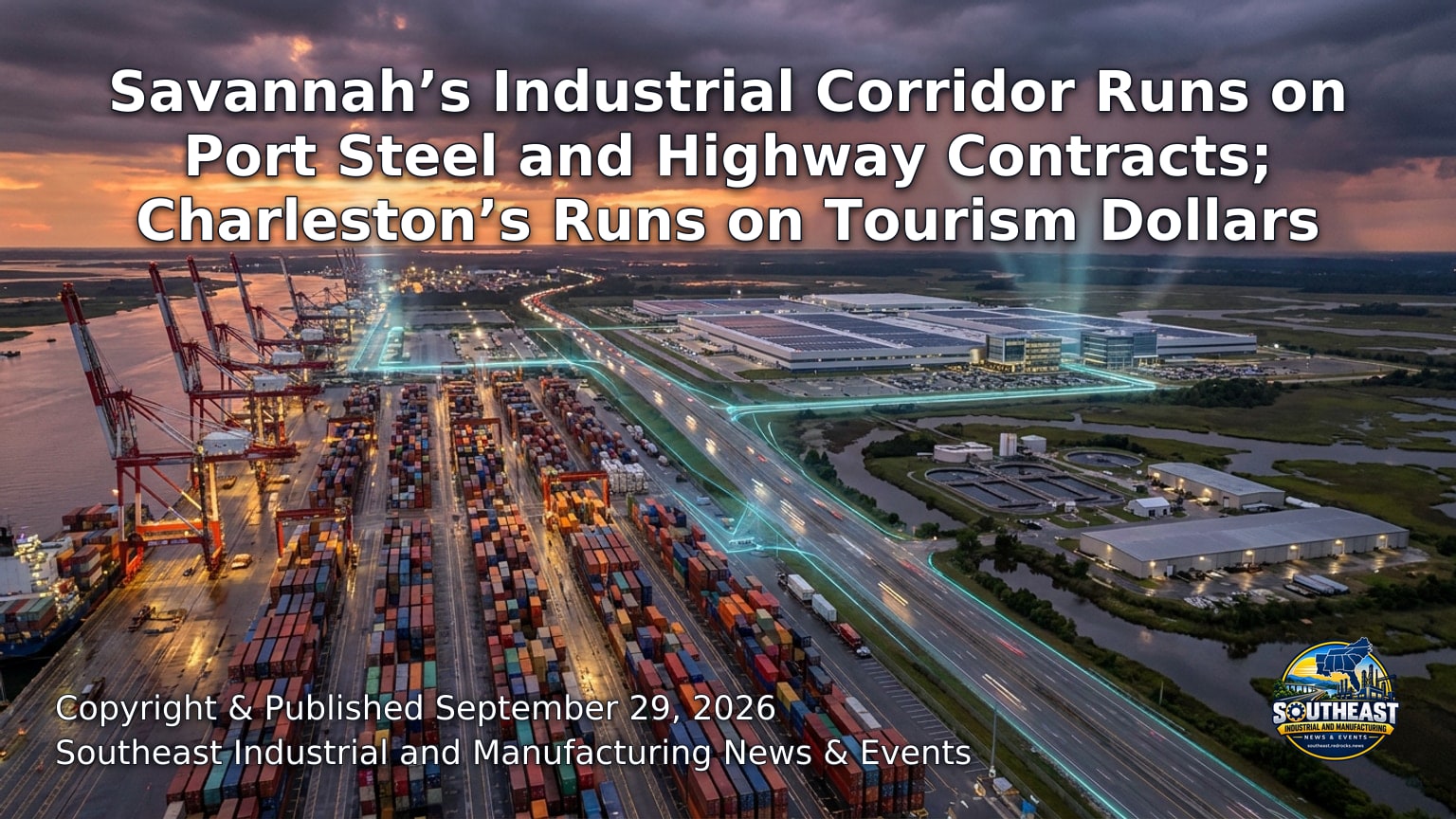
Original illustration created for Southeast Industrial and Manufacturing News & Events.

Savannah's Industrial Corridor Runs on Port Steel and Highway Contracts; Charleston's Runs on Tourism Dollars
The Port of Savannah moved 529,523 TEUs in August 2026, holding volumes steady even as global supply chains wobbled, Port Technology International reported on September 15, 2026. GPA President Kevin Price said the port had already handled more than 1 million TEUs in the first two months of the current fiscal year. That throughput sits downstream of a single fact that reshaped the region: Hyundai Motor Group's $12.6 billion Metaplant in Ellabell, the largest single investment in Georgia history, according to the company's own grand-opening release on March 26, 2025.
The Bryan County Build-Out
The Metaplant opened with an initial annual capacity of 300,000 vehicles and a stated path to 500,000, built alongside joint battery ventures with LG Energy Solution and SK On on a 2,900-acre megasite.
Economic development official Trip Tollison pointed to the shift toward hybrid models at the plant — the Kia Sportage Hybrid launched there in June 2026, per Hyundai's own materials — as a competitive advantage for the site, without addressing the supplier hiring gap directly.
Infrastructure Following the Plant, Not Leading It
The public works stacking up around Bryan and Chatham counties read less like planning ahead of demand and more like catch-up after it. Construction began in 2025 on a $146 million expansion of the surface water treatment plant in Port Wentworth, designed to provide up to 90 million gallons of water per day to support the residential and industrial growth the Metaplant triggered, The Current GA reported September 8, 2025. The Georgia Ports Authority's $5 billion master plan, as described by Seatrade Maritime News on July 30, 2026 — the only outlet to detail these figures — includes a $468 million contract to widen I-16 between I-95 and the Metaplant corridor and a $1.6 billion renovation of Ocean Terminal meant to take its capacity from 200,000 to 1.75 million TEUs.
Private capital has moved into the gaps state contracts haven't filled. Capital Development Partners, in a January 30, 2026 release, said it had completed Phase 3 of its Savannah Port Logistics Center in Pooler, a 7-acre site leased to Hyundai and Hydrofleet with a hydrogen fueling station that can refuel 14 trucks a day — a small but specific bet that zero-emission trucking between the port and the plant has enough volume to justify dedicated infrastructure now rather than later.
Charleston's Different Math
Charleston's corridor from Mount Pleasant to Daniel Island runs on a different revenue base entirely, and it serves here mainly as the contrast case. The region's hospitality industry generated a record $14 billion economic impact in 2024, the Post and Courier reported May 13, 2025, citing data from the College of Charleston's Office of Tourism Analysis. Daniel Guttentag, the office's director, attributed most of that gain not to more visitors — traffic grew only 1.2% to 7.8 million — but to a shift toward "higher-value visitors" who spent more per trip.
SC Ports handled 212,363 TEUs in September 2025, the authority reported October 16, 2025 — a full year out of step with Savannah's August 2026 figure and the most recent monthly volume available. Inland Port Greer posted an 18% year-over-year jump in rail moves over the same period, credited by the authority's president and CEO with offsetting softer ocean volumes. Port Technology International, reporting June 20, 2025, said the SC Ports board had approved a $294 million capital plan for fiscal 2026, funding completion of the Navy Base Intermodal Facility and upgrades to the Columbus Street Terminal for roll-on/roll-off cargo.
Where the Money Actually Sits
Line the numbers up and the difference in kind is plainer than the difference in scale. Savannah's public spending — the $146 million water plant, the $468 million highway contract, the $1.6 billion terminal renovation — is infrastructure sized to a single anchor tenant and its supply chain. Charleston's $294 million port plan is one piece of a broader base that includes $14 billion in tourism revenue generated independently of any single manufacturer. A supplier weighing a Georgia site is underwriting exposure to one customer's production schedule; a supplier weighing the Charleston corridor is underwriting a market with more moving parts and no equivalent single point of failure.
Garden City Terminal's dual truck transactions were averaging 43 minutes as of September 15, 2026, Port Technology International reported, tying the figure directly to the logistics demands of the Hyundai supplier network clustering nearby. Fast truck turns are the kind of detail that shows up in a bid margin before it shows up in a headline, and it suggests the Bryan County build-out is functioning at the operational level even where hiring numbers are contested.
What Suppliers Should Watch
The clearest actionable fact here is the supplier hiring lag itself, not the disputed plant headcount. The Current GA reported September 6, 2026 that offsite suppliers in Bryan and Chatham counties are behind their hiring targets while drawing on state subsidies to scale up. Neither the report nor any other document reviewed names the specific incentive agreements or a dollar figure attached to that exposure, so the clawback risk is real in structure but not yet quantified in public reporting — that gap is worth a records request before it is worth a bid decision.
Charleston's corridor carries a different kind of risk. Its industrial growth depends on ports and rail volumes that SC Ports itself describes as compensating for softer ocean cargo, not leading it. What happens to the Summerville and Upstate pipeline if that rail growth slows is not addressed in current reporting; the region's fallback, on the numbers available, is a tourism economy growing through pricing power rather than volume.
Links Verified at Time of Publish.
Sources
This article was reported from the following sources.
- Hyundai Motor Group Metaplant America Celebrates Grand Opening, Powering U.S. Economic Growth — PR Newswire, 2025-03-26
- Savannah cargo rises as GPA advances $5bn master plan — Seatrade Maritime News, 2026-07-30
- Charleston's tourism industry exceeds $14B impact — Post and Courier, 2025-05-13
- Port of Savannah container volumes remain resilient in August — Port Technology International, 2026-09-15
- Hyundai suppliers make hiring progress in exchange for public incentives — The Current GA, 2026-09-06
- SC Ports records strong intermodal and automotive growth — South Carolina Ports Authority, 2025-10-16
- Savannah's $146M water treatment plant expansion begins amid regional growth — The Current GA, 2025-09-08
- Savannah Port Logistics Center Phase 3 - Hydrogen Fueling Station — Capital Development Partners, 2026-01-30
- SC Ports approves $300 million plan to expand infrastructure — Port Technology International, 2025-06-20
- About Us - HMGMA - Hyundai Motor Group Metaplant America — Hyundai Motor Group, 2026-06-18